Remittance Advice (NetSuite)
Remittance Advice is a notification sent alongside a payment to provide essential transaction details. This information can be delivered in two primary formats:
- Electronic Remittance: Transaction details that appear directly on the recipient’s bank statement.
- Email Remittance: An optional email sent to a vendor upon payment submission, outlining the specifics of the transaction.
The plugin makes it easy to be a preferred partner by effortlessly generating both electronic and email remittances for all your payments.
Electronic Remittance
By default, the plugin submits the highest level of electronic remittance information as possible, when possible. Different payment networks and methods have different capabilities for transferring information to the recipient's bank statement.
The default implementation for ACH payments is to have CTX enabled for ACH payments, resulting in the best opportunity for high quality data to be received by your vendors in payments you submit. To make changes to your Payment Remittance, such as enabling or disabling CTX, please reach out to your bank representative.
Details about what information is extracted from the ERP for the purposes of remittance can be found below.
Email Remittance
There are two methods of Email Remittance available to you:
- The FISPAN Remittance Advice product (all payment methods supported)
- J.P. Morgan's Split Remittance product (all payment methods supported)
Remittance Advice Overview
FISPAN's Remittance Advice service automatically sends an email to the vendor’s designated email address(es) for every submitted payment. This email will contain your company name and a detailed list of the paid bills, including the Reference/Invoice #, Invoice Date, Amount, and Discount Used. If any credits were applied, the credit's reference number and amount will also be displayed.
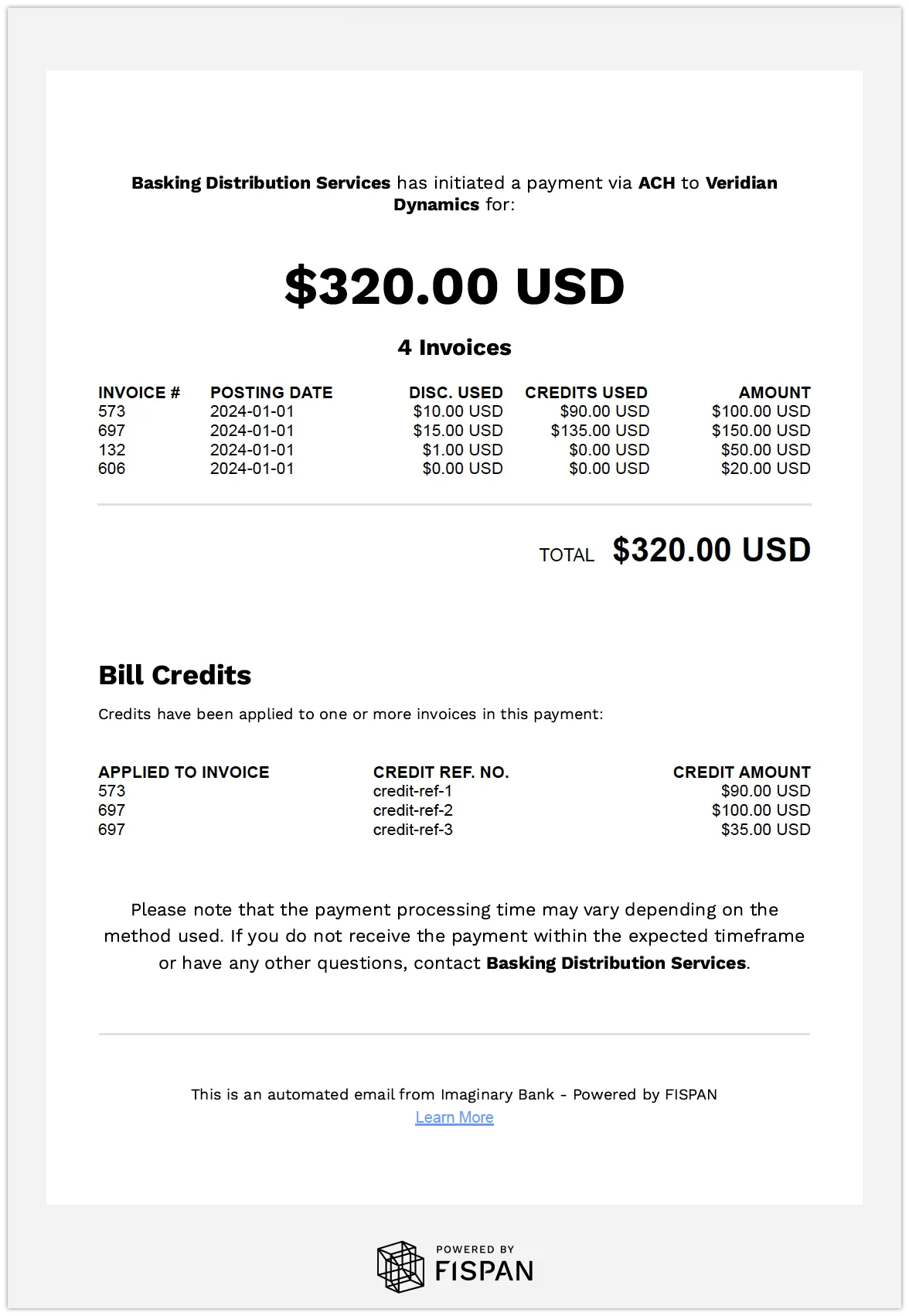
Each remittance email can be sent to up to 5 email addresses. By default, the system uses the Vendor’s email address. If you prefer to use a custom list, you can set Payables Email Addresses on the custom tab of the Vendor's profile in NetSuite (or the Payment Methods page in Sage Intacct and Business Central).
The email will be sent from FISPAN and feature your bank's branding. As a user, you can customize several settings:
- "Reply-To" Email Address: Configure an address that the recipient will see and use if they reply to the remittance advice.
- Receive Copies: Choose an email address to receive copies of all sent remittance advice.
- Alternative Company Name: You may request that we configure a different company name to appear in the email on a per-bank account basis.
Remittance emails are submitted shortly after the payment is successfully sent from your ERP. The subject line of the email will appear as: "Your customer {CUSTOMER_NAME} has initiated a payment."
IMPORTANT: Enabling the GROUP BILLS FOR PAYMENT function means that only one remittance email is sent for multiple bills grouped into a single payment for the same vendor.
If this feature is not enabled, each paid bill is treated as a unique payment with its own remittance email, which results in multiple payments and multiple emails.
Configuring Remittance Advice
Follow these steps in the FISPAN Portal to enable and manage your Remittance Advice settings.
Navigate to the App Center
Log in to https://sys.fispan.live/ (or Sandbox: https://sandbox.fispan.cloud/) using your FISPAN Portal credentials.
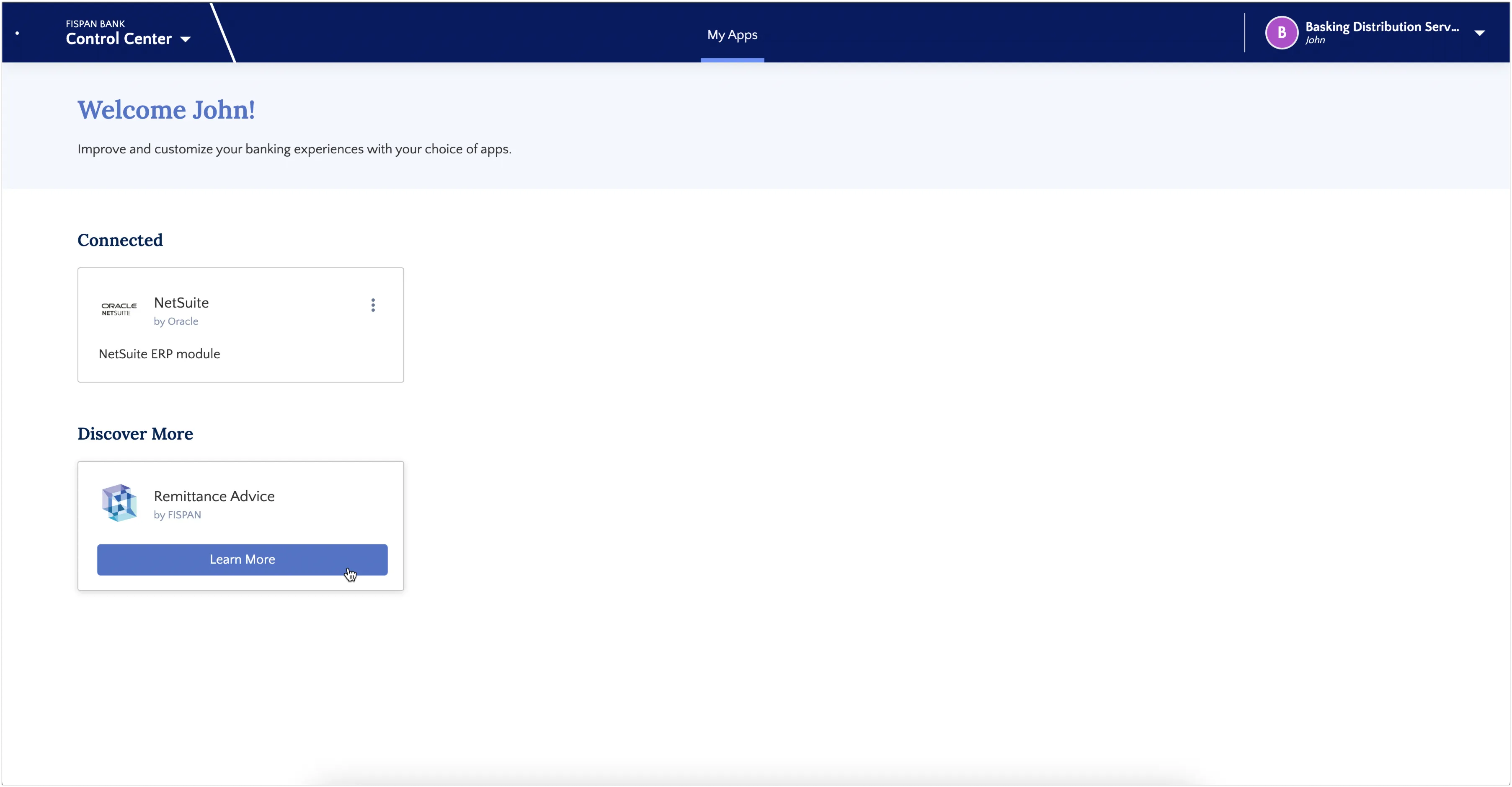
If not already there, navigate to the App Center.
Remittance Advice, as well as any other available extra features, will be displayed in the lower Discover More section.
Enable Remittance Advice
To begin enabling Remittance Advice, hover over the card and select Learn More.
The Learn More button will begin the short setup process.
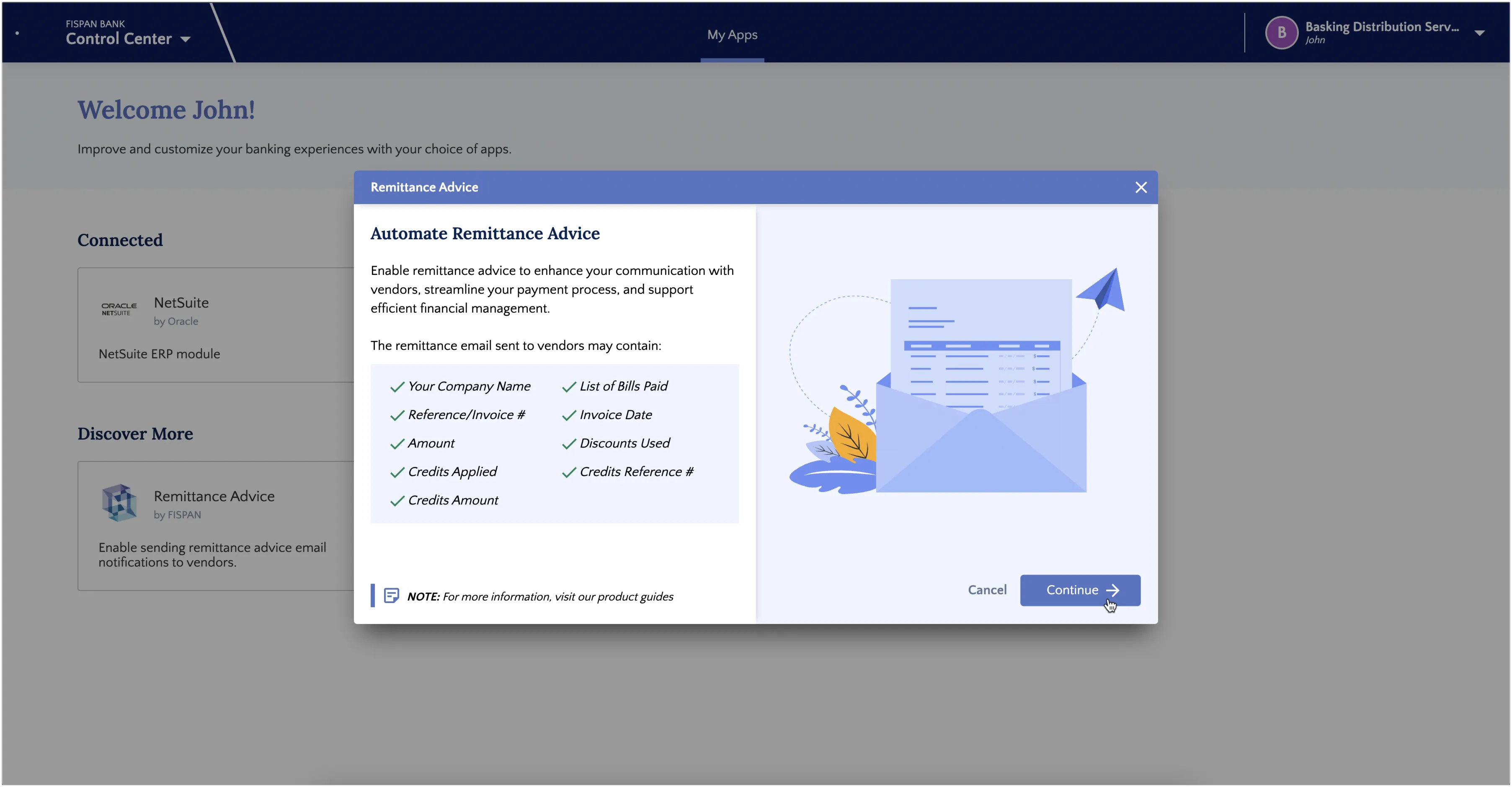
NOTE: Don't see Remittance Advice in the Connected or Discover More sections? Please reach out to FISPAN Support to have this product made available to you.
Configure Remittance Advice
In order to complete the setup, we require a few details from you.
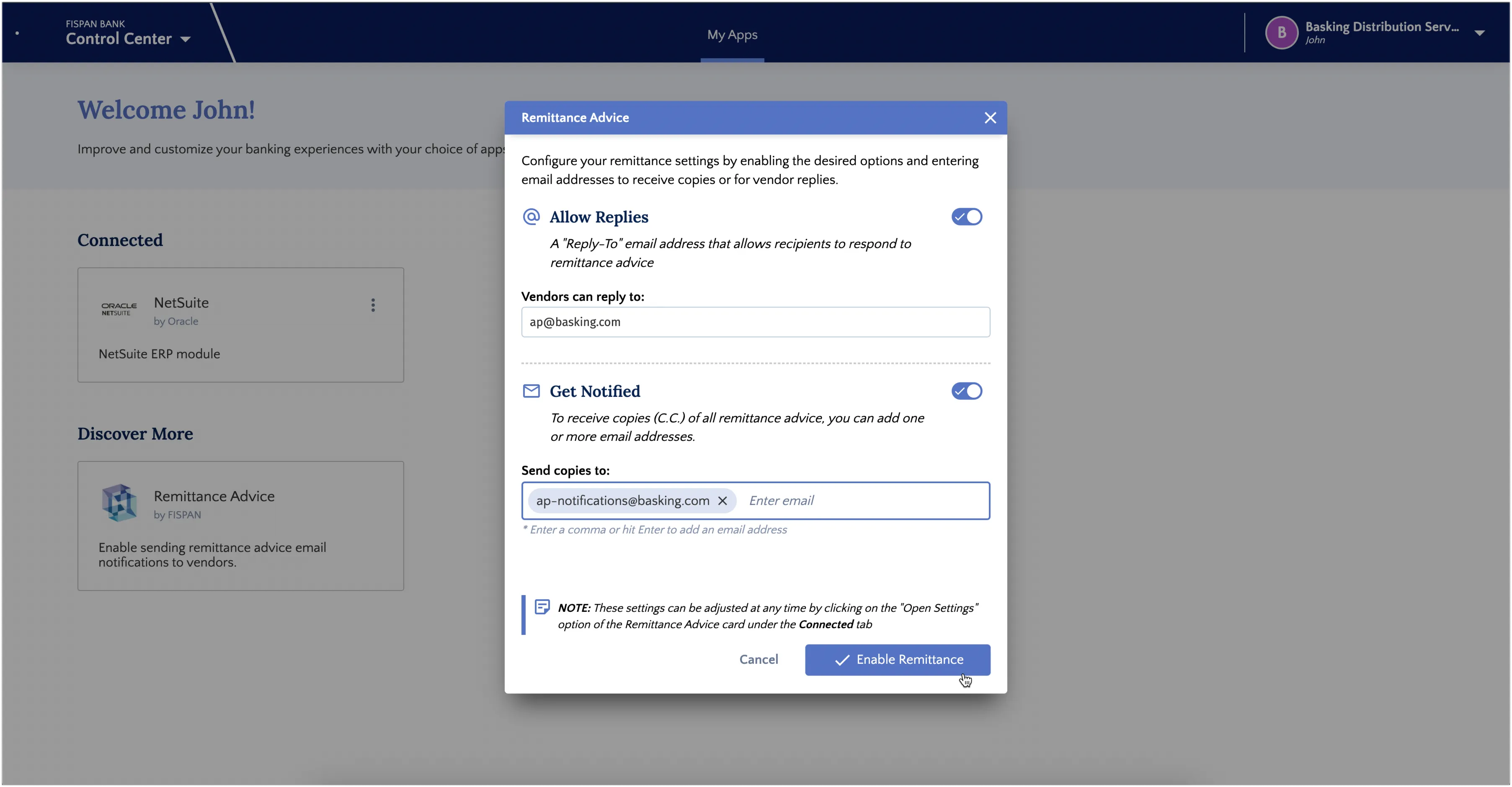
All emails come from the unmonitored inbox [email protected]. If a vendor replies to a remittance email, their response will be redirected to the address you specified in the Vendors can reply to field.
Internal copies of all remittance advices will be sent to the emails noted for copies.
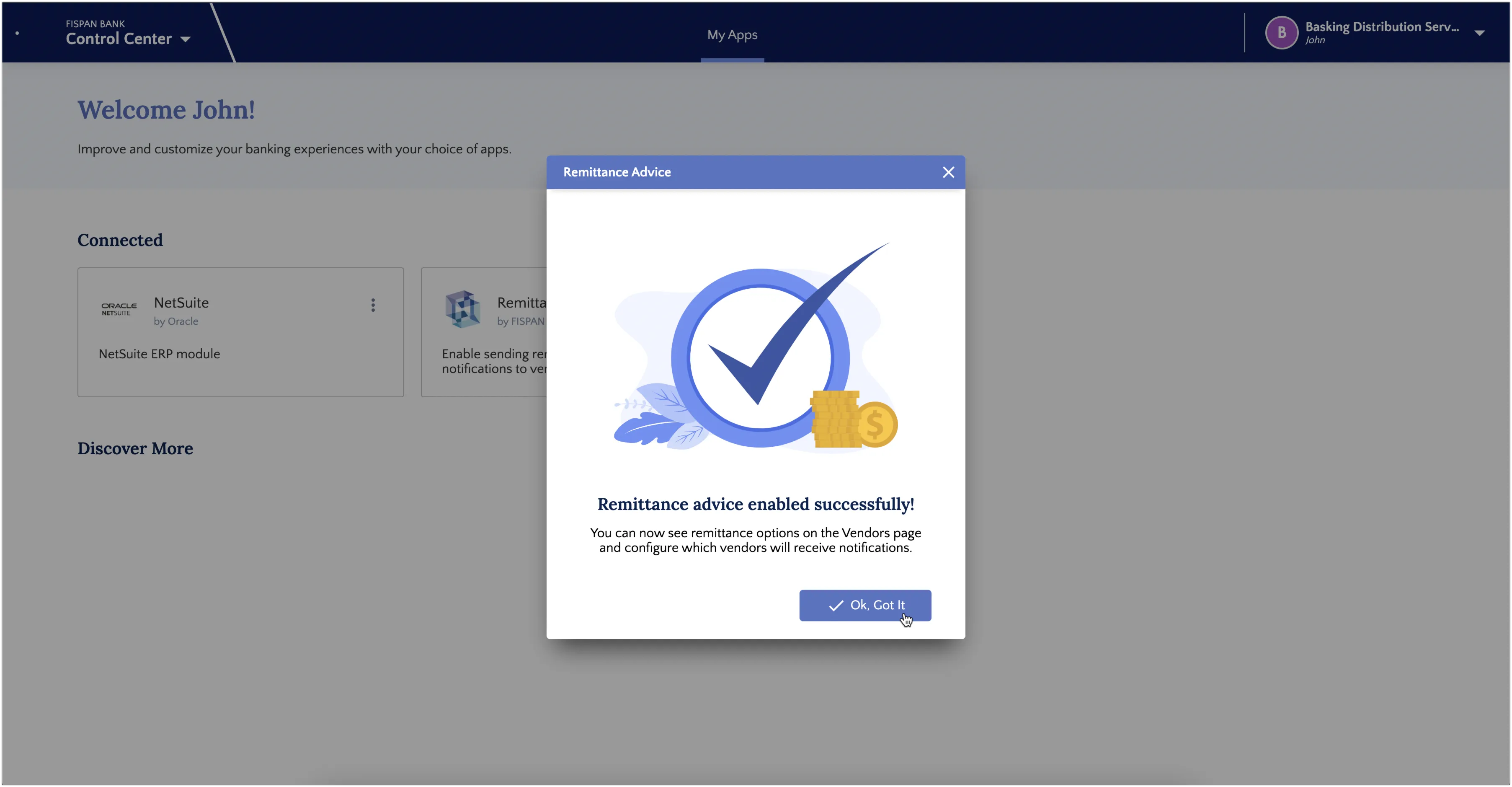
Once Enable Remittance is selected, it can take up to 15 minutes for the changes to come into effect.
Modify Remittance Advice Settings
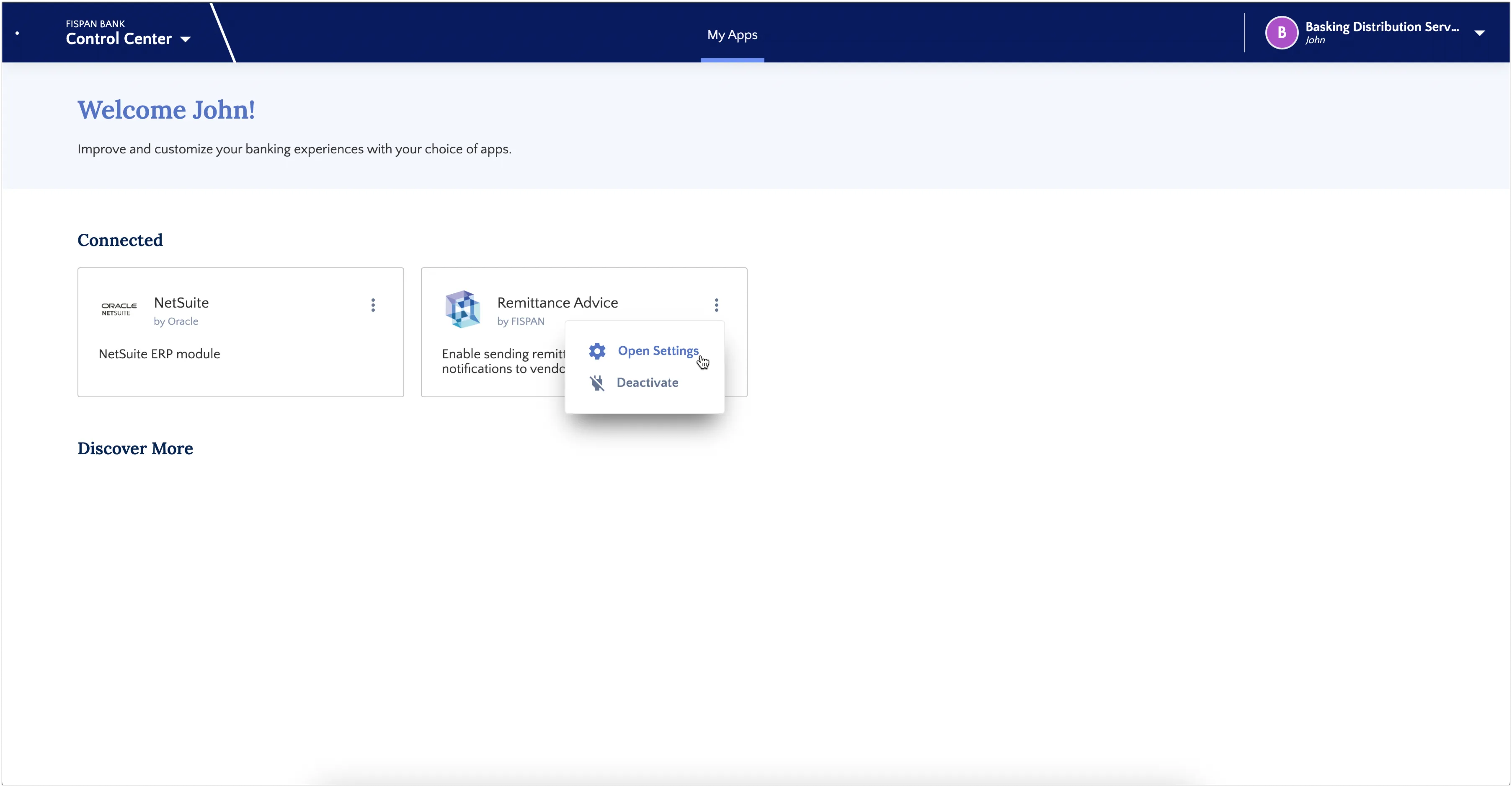
You can view or change your current settings through the App Center. Find the Remittance Advice card, select its drawer, and choose Open Settings. If you need to disable the integration entirely, select Disable. The change may take up to 15 minutes to come into effect.
J.P. Morgan Split Remittance
This email remittance product leverages the bank's Secure Email service and includes detailed and rich information about the payments submitted.
- Requires a JPM (H2H Payments/Paysource) implementation project.
- There are fees associated with this solution.
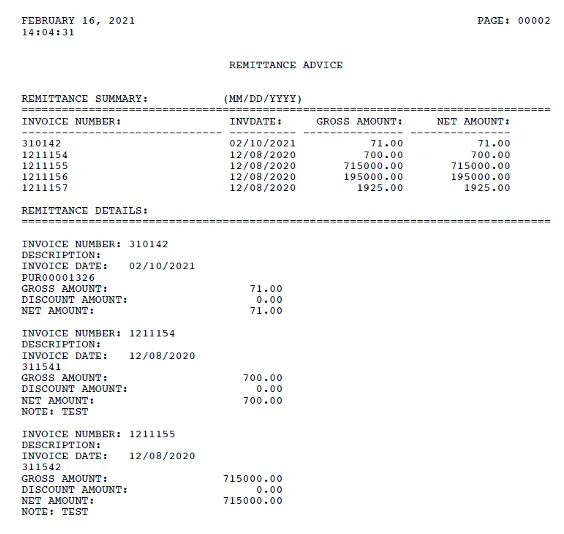
Important Note: Split Remittance Emails are sent once the payment is released from Host-to-Host.
To enable this product, please reach out to your bank representative.
Vendor and Bill data are used to support both electronic (ACH) and email remittances. To ensure high-quality remittance delivery, please verify the following fields in NetSuite.
NetSuite Vendor Object
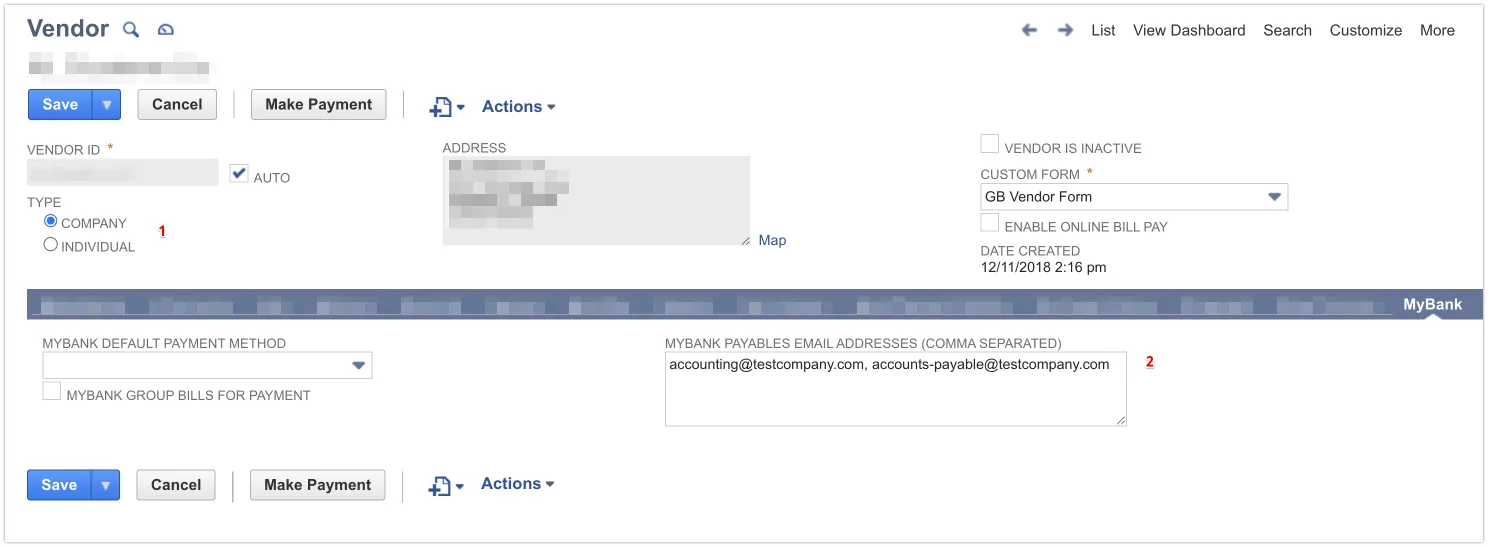
Two primary details on the Vendor record impact remittance quality:
- Individual vs. Company: CTX (Corporate Trade Exchange), which allows for extended payment remittance data, is only available when the recipient is set to Company.
- Payables Email Addresses: You can provide a comma-separated (CSV) list of email addresses in this field to override the default "Email" value on the Vendor record. These addresses will be used for all payment-related communications, (including Remittances and Virtual Card, where applicable)
NetSuite Bill Object
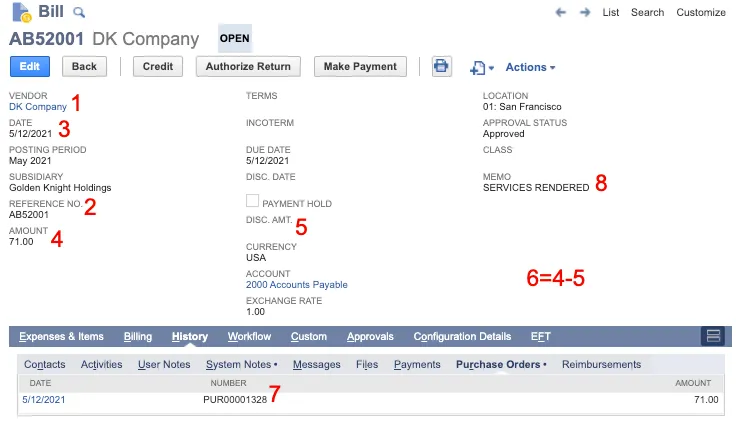
The remittance information sent with your payment is pulled from the fields you’ve populated in NetSuite. The record in NetSuite can advise on what was populated for the payment. Below are those fields:
- Vendor Name
- Reference Number(s)
- Posting date from Invoice
- Gross invoiced amount
- Discount applied
- Net remitted amount
- Purchase Order(s)
- Memo
Unlisted fields, such as Billing Address, may be used for other purposes, such as payment routing and file creation.